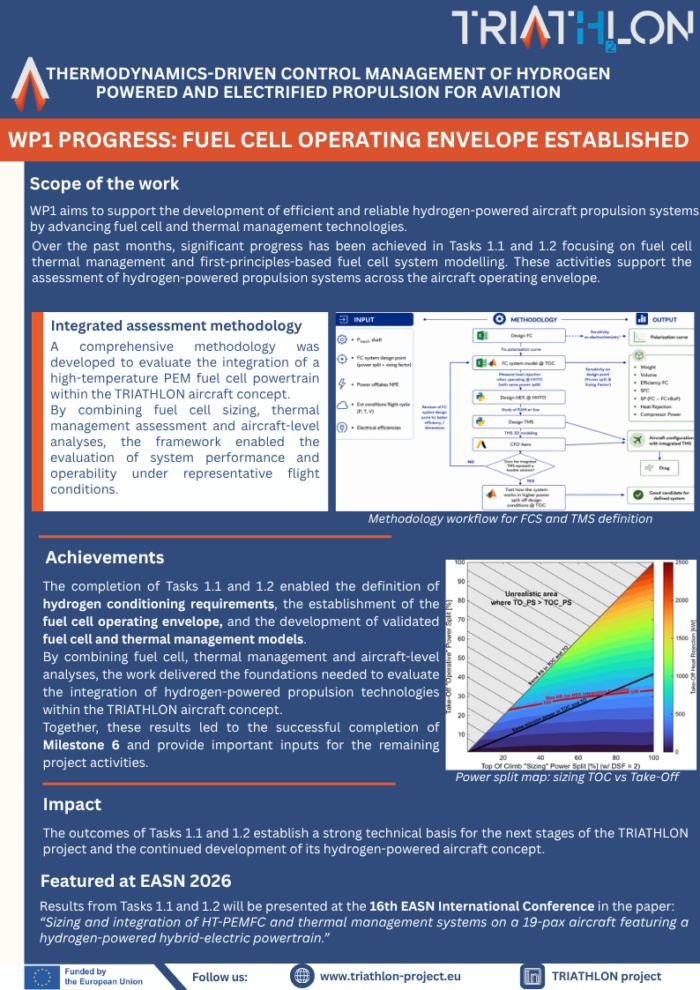

The TRIATHLON project has successfully achieved Milestone 6: “Working envelope of the fuel cell determined by means of simulation”, marking an important step in the development of the project’s hydrogen-powered hybrid-electric aircraft concept.
The milestone was reached through the completion of Tasks 1.1 and 1.2 of Work Package 1 (WP1), led by ERGON Research, which focused on fuel cell thermal management and first-principles-based fuel cell system modelling.
Scope of WP1 activities
WP1 aims to support the development of efficient and reliable hydrogen-powered aircraft propulsion systems by advancing fuel cell and thermal management technologies. To achieve this objective, the project combines detailed simulation tools and system-level analyses to assess the performance and operability of hydrogen-powered propulsion architectures across the aircraft operating envelope.
Tasks 1.1 and 1.2 addressed two complementary areas of research. While Task 1.1 focused on fuel cell thermal management through high-fidelity simulations, Task 1.2 concentrated on the development of a first-principles-based fuel cell system model integrating electrochemistry, hydrogen and air handling, and thermal management.
Developing an integrated assessment methodology
A key outcome of the work was the development of a comprehensive methodology for evaluating the integration of a high-temperature proton exchange membrane fuel cell (HT-PEMFC) powertrain within the TRIATHLON aircraft concept.
The methodology combines fuel cell sizing, thermal management assessment and aircraft-level analyses into a unified framework. Using representative flight conditions, the project team evaluated system performance, operability and integration constraints under demanding operating scenarios, providing a holistic understanding of fuel cell integration within the TRIATHLON aircraft concept.
Key results
The completion of Tasks 1.1 and 1.2 delivered several important results for the TRIATHLON aircraft concept. The work enabled the definition of hydrogen conditioning requirements, the development and validation of fuel cell and thermal management system models, and the establishment of the fuel cell operating envelope through combined fuel cell, thermal management and aircraft integration analyses.
The results also helped assess system operability under representative flight conditions and identify the contribution of the fuel cell to the hybrid-electric propulsion architecture. Together, these achievements led to the successful completion of Milestone 6, providing important inputs for subsequent project activities.
Sharing the results
The results of Tasks 1.1 and 1.2 will also be presented at the 16th EASN International Conference in the paper: “Sizing and integration of HT-PEMFC and thermal management systems on a 19-pax aircraft featuring a hydrogen-powered hybrid-electric powertrain.”