Can multi-state hydrogen storage help make hydrogen-powered aviation a reality?
This question was at the heart of two TRIATHLON presentations delivered at WCCM-ECCOMAS 2026, held in Munich, Germany, from 19–24 July 2026. Bringing together more than 5,000 participants, the event was the largest edition of the conference to date and a key meeting point for the global computational mechanics community.
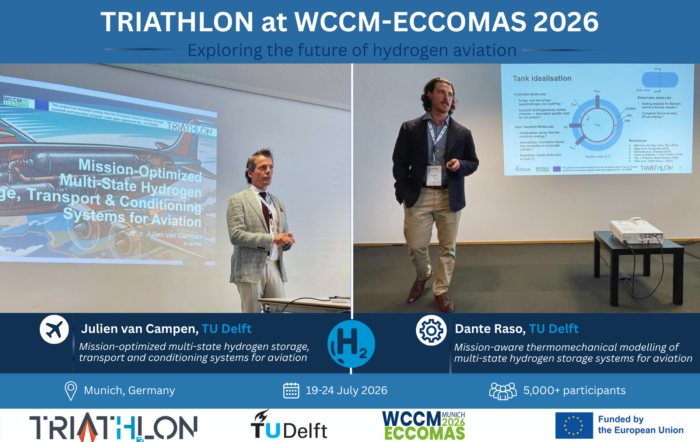
Representing the TRIATHLON project, Julien van Campen, Project Coordinator, and Dante Raso from TU Delft presented complementary research addressing some of the challenges associated with integrating hydrogen technologies into future aircraft.
Julien van Campen’s presentation, Mission-optimized multi-state hydrogen storage, transport and conditioning systems for aviation, explored the potential of multi-state hydrogen storage systems and demonstrated how thermo-mechanical modelling can support their optimisation under different flight conditions.
Dante Raso presented Mission-aware thermomechanical modelling of multi-state hydrogen storage systems for aviation, showcasing TOPLAB, a thermo-mechanical modelling tool developed to analyse the behaviour of hydrogen storage systems under realistic operational conditions.
The initial results are promising and suggest that multi-state hydrogen storage concepts have significant potential for hydrogen storage, transport, and conditioning in aviation applications.
Together, the presentations demonstrated how advanced modelling capabilities can help researchers better understand, evaluate, and optimise hydrogen storage solutions for future aircraft.
Beyond the technical content, the session stood out for the strong engagement it generated. Audience members actively participated in the discussion, raising numerous questions and exchanging ideas with the presenters. Reflecting on the experience, the TU Delft team left Munich inspired by the exchanges with fellow researchers and encouraged by the strong interest shown in TRIATHLON’s work.
Participation in WCCM-ECCOMAS 2026 offered an excellent opportunity to share the project’s latest developments, connect with experts from around the world, and contribute to the broader conversation on the future of sustainable aviation.