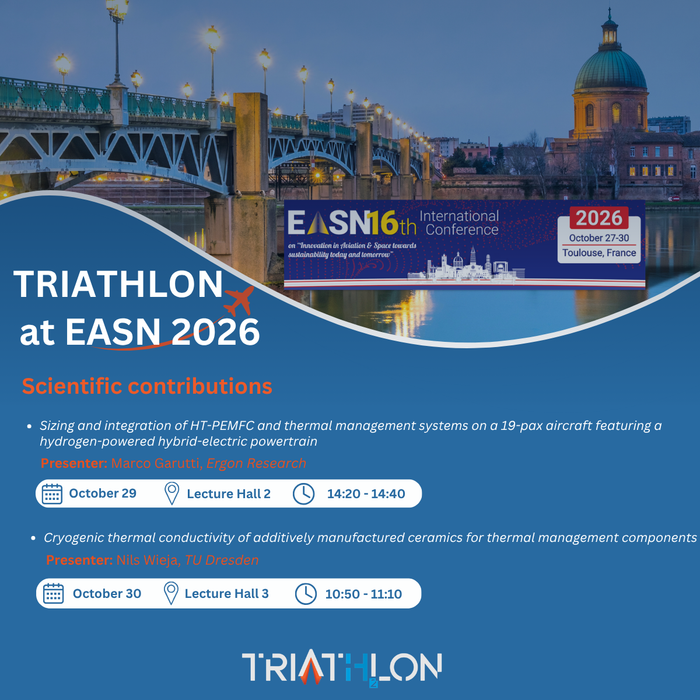
The TRIATHLON project will be represented at the 16th EASN International Conference, taking place from 27 to 30 October 2026 in Toulouse, France. The event brings together researchers, industry representatives, and innovators to discuss the technologies shaping the future of sustainable aviation.
As part of the conference programme, TRIATHLON partners will present two research contributions addressing key challenges associated with hydrogen-powered aircraft, ranging from advanced materials for cryogenic applications to the integration of fuel-cell-based propulsion systems.
Scientific contributions
On 29 October, Marco Garutti (Ergon Research) will present:
“Sizing and integration of HT-PEMFC and thermal management systems on a 19-passenger aircraft featuring a hydrogen-powered hybrid-electric powertrain.”
The study examines the integration of high-temperature proton exchange membrane fuel cells (HT-PEMFCs) and thermal management systems within a regional hydrogen-powered aircraft concept. By assessing factors such as system mass, efficiency, heat rejection, and installation requirements, the research helps identify design trade-offs and integration strategies for future hybrid-electric aviation platforms.
On 30 October, Nils Wieja (Institute of Lightweight Engineering and Polymer Technology (ILK). Technische Universität Dresden) will present:
“Cryogenic thermal conductivity of additively manufactured ceramics for thermal management components.”
The research investigates the thermal conductivity of 3D-printed technical ceramics across a temperature range relevant to future hydrogen-powered aircraft. The work contributes to understanding the suitability of these materials for thermal management applications, including compact heat exchangers and hydrogen conditioning systems operating under cryogenic conditions.
Addressing key challenges in hydrogen-powered flight
Hydrogen-powered aircraft introduce new engineering challenges, particularly in relation to thermal management and system integration. The research presented by TRIATHLON partners at EASN 2026 explores these challenges from complementary perspectives, combining material characterisation with aircraft-level design and analysis.
The findings contribute to a better understanding of how future hydrogen aircraft can efficiently manage extreme temperature conditions while integrating advanced propulsion technologies into viable aircraft concepts.
These contributions reflect the collaborative research efforts of Ergon Research, Institute of Lightweight Engineering and Polymer Technology (ILK). Technische Universität Dresden, and Lithoz within the TRIATHLON Project.