
The aviation sector is undergoing a major transformation as hybrid-electric and hydrogen-powered propulsion technologies move closer to reality. While these advances promise significant environmental benefits, they also introduce new thermal management challenges, requiring materials capable of operating reliably under increasingly demanding conditions.
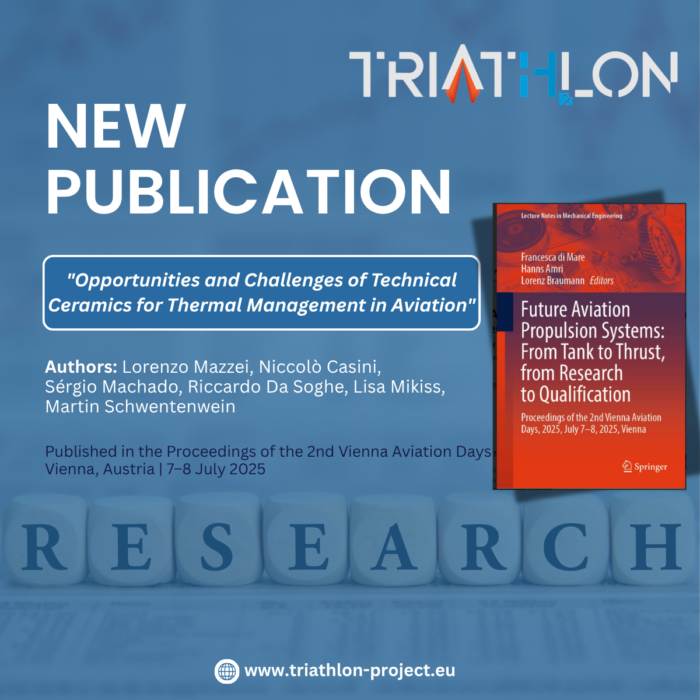
A new conference paper developed within the TRIATHLON project, titled “Opportunities and Challenges of Technical Ceramics for Thermal Management in Aviation”, has been published in the Proceedings of the 2nd Vienna Aviation Days 2025, held on 7–8 July 2025 in Vienna, Austria.
The paper investigates the potential of advanced technical ceramics for aerospace thermal management applications. Compared to conventional metallic materials commonly used in aviation, such as aluminium, copper, and nickel-based alloys, technical ceramics offer several advantages, including low weight, thermal stability, and strong resistance to harsh chemical and thermal environments.
In particular, the study focuses on the use of 3D-printed technical ceramics produced through Lithography-based Ceramic Manufacturing (LCM) technology. The authors examine how these materials could support future aircraft systems operating under extreme conditions, from the cryogenic temperatures associated with hydrogen storage to the high-temperature environments found in gas turbine applications.
The publication provides a comparative review of the thermomechanical and chemical properties of technical ceramics and conventional aerospace alloys. It also presents preliminary assessments of innovative ceramic thermal management components designed using Computational Fluid Dynamics (CFD) simulations and manufactured through advanced additive manufacturing techniques.
While experimental validation activities are still ongoing, the results presented in the paper contribute to building a knowledge base that will support the future development of thermal management technologies for more sustainable aviation.
The publication reflects TRIATHLON’s commitment to advancing innovative materials and technologies that can help enable the next generation of cleaner, safer, and more efficient aircraft. Congratulations to the authors on their contribution to aviation research.
This work was carried out with the support of TRIATHLON partners Lithoz and Ergon Research.
Read the publication here.