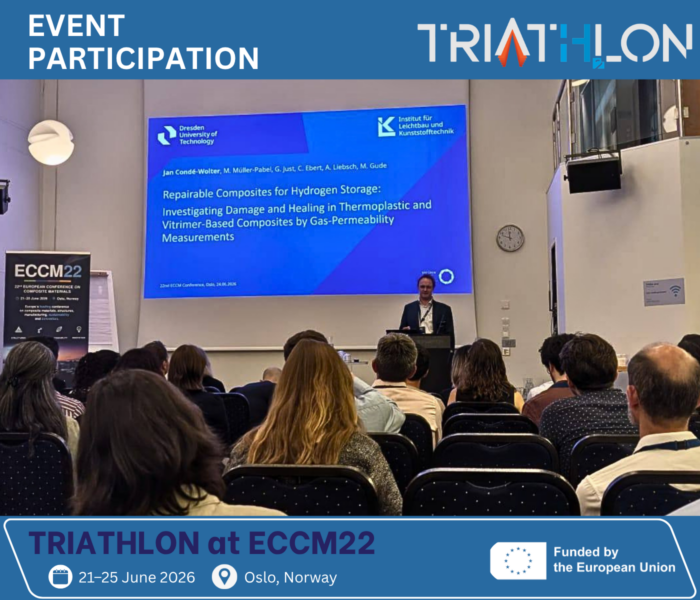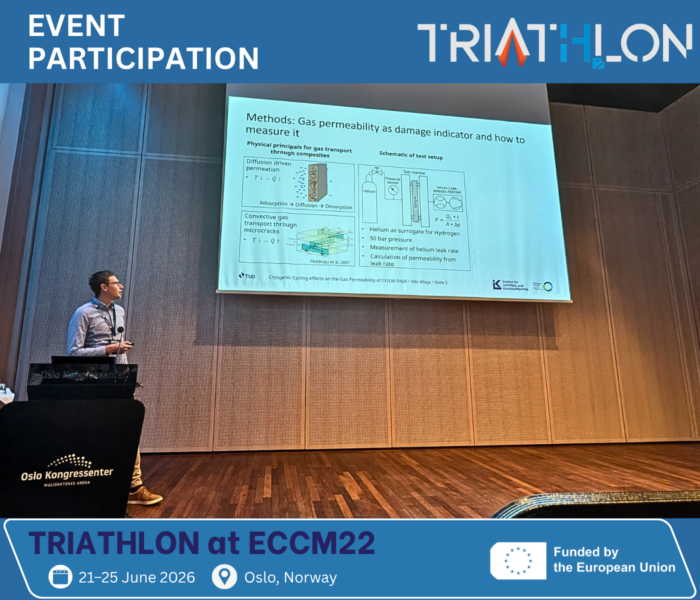
TRIATHLON was represented at the 22nd European Conference on Composite Materials (ECCM22), held from 21–25 June 2026 in Oslo, Norway. Recognised as Europe’s leading conference on composite materials and structures, ECCM22 brought together researchers, engineers, and industry experts to discuss the latest developments in advanced materials, with this year’s edition placing a strong emphasis on sustainability, disruptive technologies, and emerging applications across sectors including aerospace, energy, automotive, maritime, and infrastructure. The conference was organised by the Laboratory of Advanced & Sustainable Engineering Materials (ASEMlab) at the Norwegian University of Science and Technology (NTNU).
Representing the project, Nils Frederik Wieja and Jan Conde-Wolter from the Institute of Lightweight Engineering and Polymer Technology (ILK), TU Dresden, presented two papers showcasing TRIATHLON’s ongoing research into advanced composite materials for hydrogen storage applications.
The first paper, “Cryogenic Cycling Effects on the Gas Permeability of CF/LM-PAEK”, investigated the suitability of carbon-fibre-reinforced LM-PAEK composites for future linerless cryo-compressed hydrogen storage vessels. The research examined how mechanical damage and repeated cryogenic cycling affect helium permeability and gas barrier performance under high-pressure conditions. The findings contribute to a better understanding of how composite materials behave in demanding hydrogen storage environments, supporting the development of future linerless storage vessel concepts.
The second contribution, “Repairable Composites for Hydrogen Storage: Investigating Damage and Healing in Thermoplastic and Vitrimer-Based Composites by Gas-Permeability Measurements”, examined the potential of repairable composite materials for future hydrogen storage applications. The research investigated how impact damage influences gas permeability and demonstrated that both thermoplastic and vitrimer-based composites can recover their original gas barrier properties after repair. These findings demonstrate the potential of repairable composite structures for future hydrogen storage vessels, showing that key gas barrier properties can be effectively restored after impact damage through repair.
Both studies contribute to addressing key challenges in the use of composite materials for hydrogen-powered aviation. By improving the understanding of material behaviour under extreme operating conditions and exploring innovative repair concepts, the research supports the development of safer, lighter, and more resilient hydrogen storage systems.
Participation in ECCM22 provided an opportunity to share TRIATHLON’s latest results with the international composites community, exchange knowledge with leading experts, and strengthen collaborations that can help accelerate the transition towards sustainable aviation technologies.
TRIATHLON congratulates the TU Dresden team for their valuable contributions and for successfully representing the project at one of Europe’s most important events dedicated to composite materials research.