
Within the TRIATHLON Project, Work Package 2 addresses several aspects of hydrogen storage system design for next-generation aircraft. As part of these activities, the team at Delft University of Technology is contributing modelling and evaluation capabilities to support the development and assessment of multi-state hydrogen storage concepts.
Hydrogen-powered aviation presents unique storage challenges. Designers must balance mass, volume, thermal behaviour, and integration constraints while ensuring reliable hydrogen delivery throughout the mission. Multi-state architectures, which combine hydrogen stored in different physical states within the same aircraft, offer potential advantages in flexibility and performance. However, they also introduce additional system interactions and complexity, making consistent evaluation essential during the early design stages.
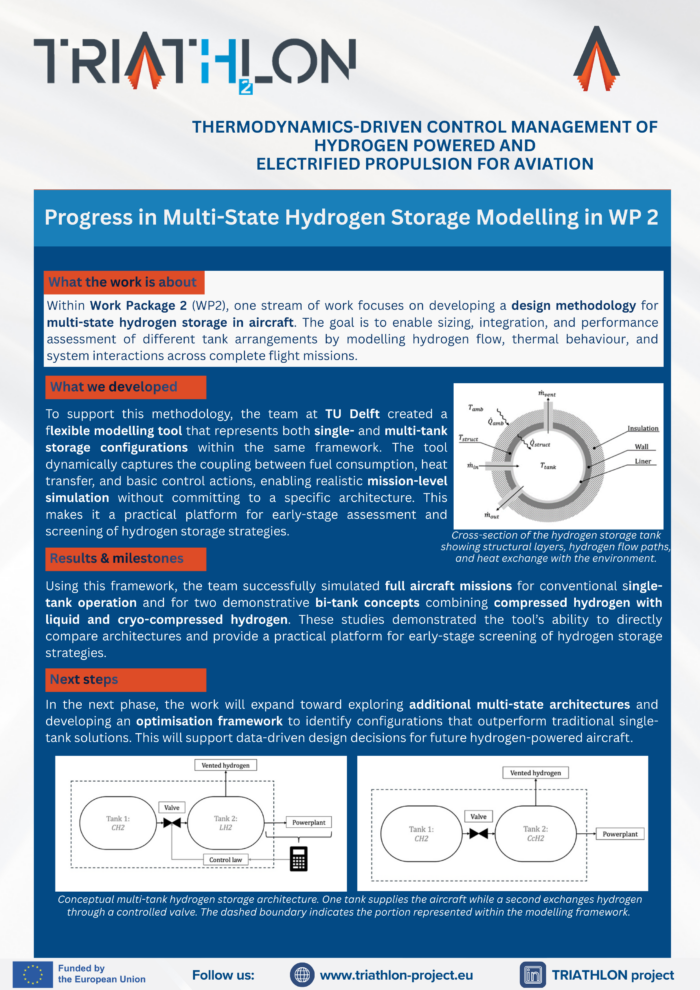
To address this need, a flexible mission-level modelling framework has been developed. The tool is capable of representing both single-tank systems and multi-tank configurations within a unified simulation environment. It captures the dynamic coupling between hydrogen consumption, thermal effects, and basic control actions, allowing storage behaviour to be analysed over complete flight missions. By resolving these interactions dynamically, the framework allows direct comparison of conventional single-tank solutions with more advanced multi-state concepts, without committing to a specific architecture. As such, it provides a practical basis for early-stage assessment and screening of hydrogen storage strategies.
Recent work has focused on demonstrating and validating this capability through representative mission simulations. Full-flight analyses were first carried out for a conventional single-tank storage system to establish a baseline. The framework was then applied to two demonstrative bi-tank concepts that combine compressed hydrogen with either liquid hydrogen or cryo-compressed hydrogen storage.
Building on these results, the next phase will expand the exploration of viable multi-state configurations and introduce an optimisation framework aimed at identifying storage arrangements that may outperform traditional single-tank concepts. This work will support more informed design decisions and provide quantitative input to subsequent project activities focused on detailed thermo-fluid modelling and system integration.
By establishing a robust and flexible modelling foundation, Work Package 2 contributes practical tools for the systematic evaluation of hydrogen storage strategies, supporting the broader goal of enabling feasible and efficient hydrogen-powered aircraft.