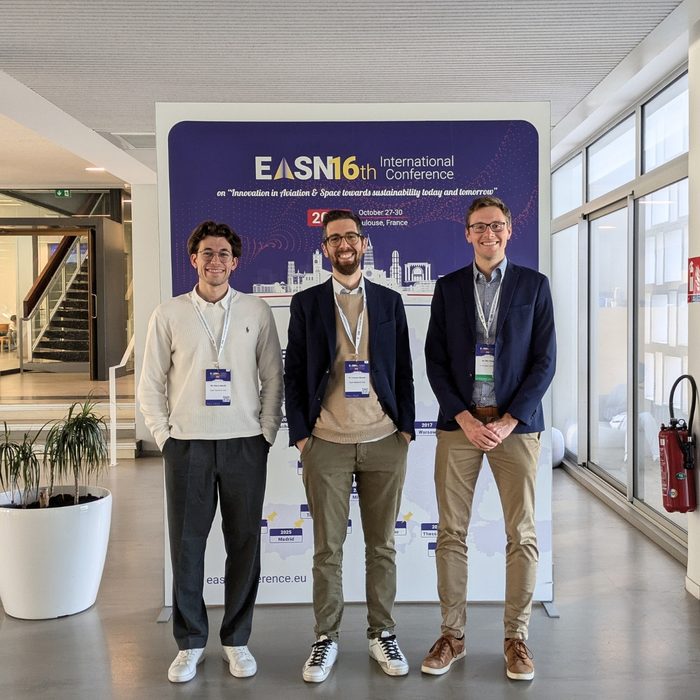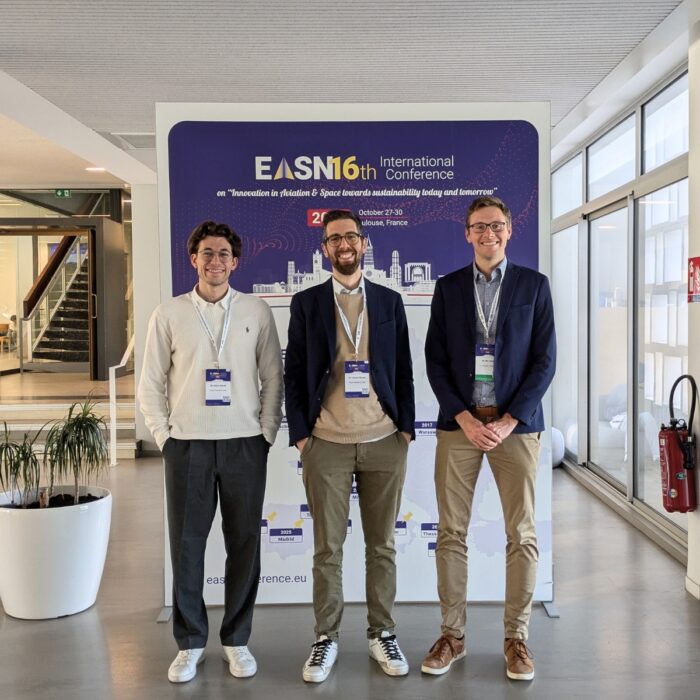

TRIATHLON research was presented at the 16th EASN International Conference, held in Toulouse, France, from 27 to 30 October 2026. The conference provided an opportunity to bring the project’s work on hydrogen-powered aviation to the wider aerospace research community.
Two TRIATHLON contributions addressed a common challenge from different perspectives: how to manage demanding thermal conditions in future hydrogen aircraft, from the behaviour of materials at cryogenic temperatures to the integration of fuel cells and thermal management systems at aircraft level.
Integrating Fuel Cells and Thermal Management at Aircraft Level
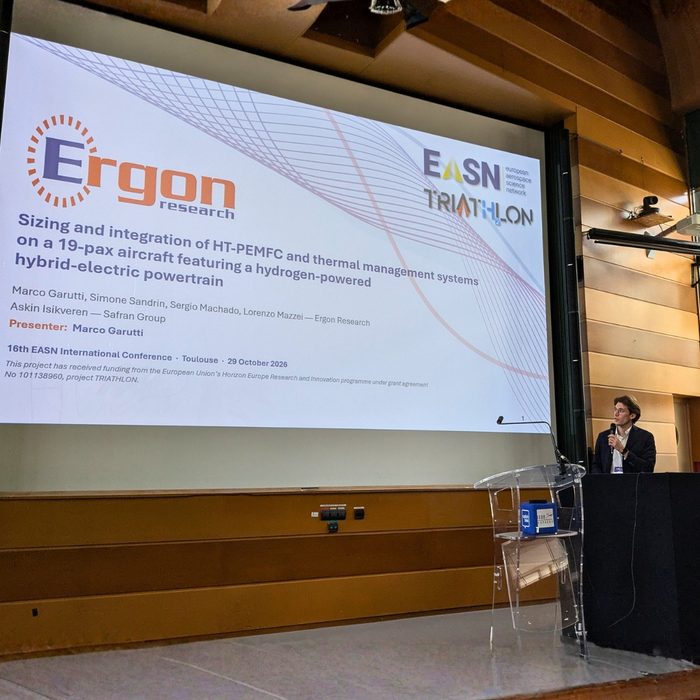
Marco Garutti from Ergon Research presented research on the sizing and integration of HT-PEM fuel cells and thermal management systems for a 19-pax aircraft featuring a hydrogen-powered hybrid-electric powertrain.
The work examines how high-temperature proton exchange membrane fuel cells (HT-PEMFCs) can be integrated into a regional aircraft concept alongside the required thermal management architecture. The study considers aircraft-level parameters including system mass, efficiency, parasitic electrical power, rejected thermal power and drag.
Preliminary sizing indicates that hot-and-high take-off conditions can become particularly demanding for radiator design, highlighting the importance of balancing the benefits of fuel-cell hybridisation with the thermal requirements associated with its integration.
Understanding Materials Under Cryogenic Conditions
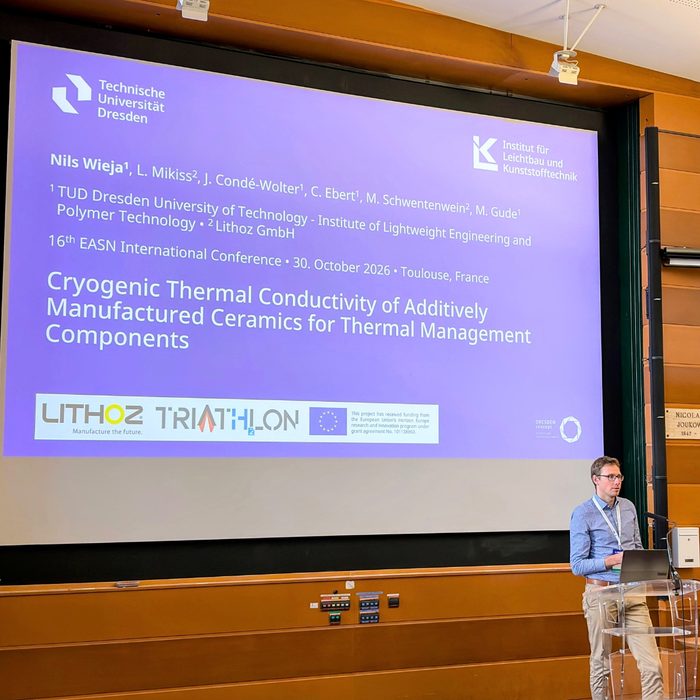
Nils Wieja from ILK, TU Dresden presented research on the cryogenic thermal conductivity of additively manufactured ceramics for thermal management components.
The work investigates 3D-printed technical ceramics, including aluminium oxide (Al₂O₃) and aluminium nitride (AlN), across temperatures from 20 K to 293 K. Understanding how these materials conduct heat at very low temperatures is important when considering their use in future hydrogen conditioning and thermal management systems.
The research also explores the potential of additive manufacturing to produce technical ceramic components suitable for compact heat exchangers, where material performance across a wide temperature range is particularly relevant.
From Materials to Aircraft Integration
The two contributions illustrate the range of thermal challenges that need to be addressed in hydrogen-powered aviation. At one end, understanding how materials behave at cryogenic temperatures can inform the design of components associated with hydrogen systems. At the other, aircraft-level modelling helps assess how fuel cells, cooling architectures and their associated requirements can be integrated into future aircraft concepts.
By examining these challenges at different scales, TRIATHLON is building knowledge to support the development and integration of technologies for future hydrogen-powered aircraft.
Participation in conferences such as EASN gives TRIATHLON the opportunity to share these results with the wider aerospace community, exchange knowledge with researchers and industry, and contribute to ongoing discussions on the technologies needed for more sustainable aviation.