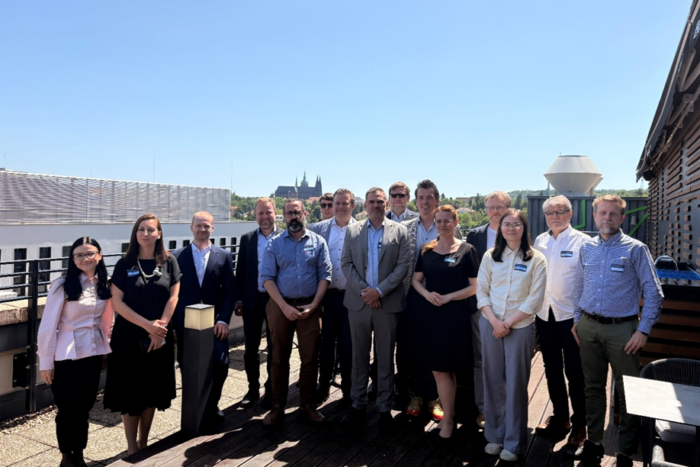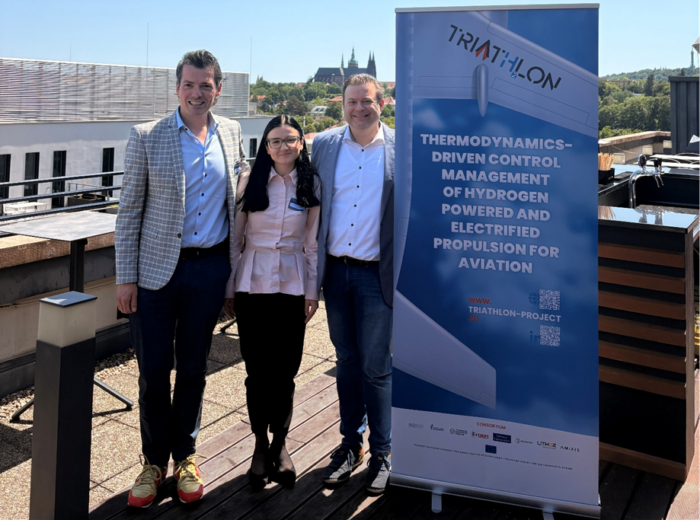
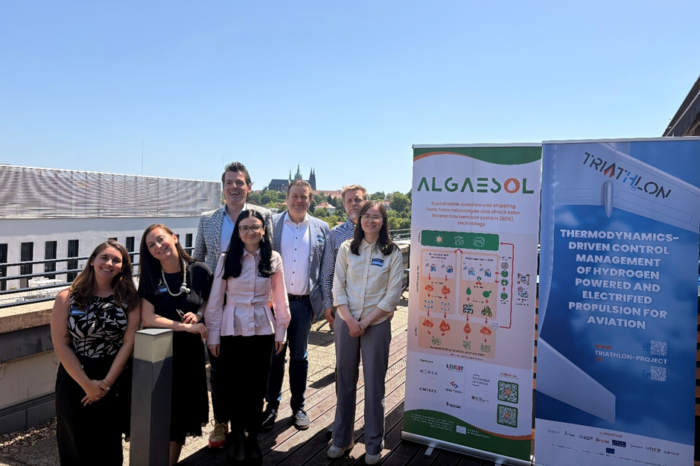
On 26 May 2026, Prague hosted Clean Fuel Horizons, a one-day workshop dedicated to the technologies, systems and partnerships shaping the future of sustainable fuels. Organised by AMIRES and powered by the Horizon Europe projects TRIATHLON and ALGAESOL, the event convened participants from across industry, academia, research and policy to explore how hydrogen and renewable fuel solutions can support Europe’s transition to a low-carbon economy.
Held just ahead of the TRIATHLON consortium meeting, the workshop created a timely platform for discussion at a moment when sustainable fuel technologies are gaining increasing attention and industrial relevance. Across the day, speakers and participants examined not only the scientific and engineering advances behind these technologies, but also the wider questions of scale-up, deployment and policy alignment.
The workshop opened by situating the conversation within the broader European landscape for hydrogen and alternative fuels. Setting the tone for the sessions that followed, the opening discussion highlighted the growing gap between ambition and implementation and underscored the need to align technical innovation with market realities, infrastructure readiness and regulatory frameworks. Rather than presenting clean fuels as a single-track solution, the workshop approached the topic as a multi-dimensional challenge requiring complementary pathways and stronger collaboration across sectors.
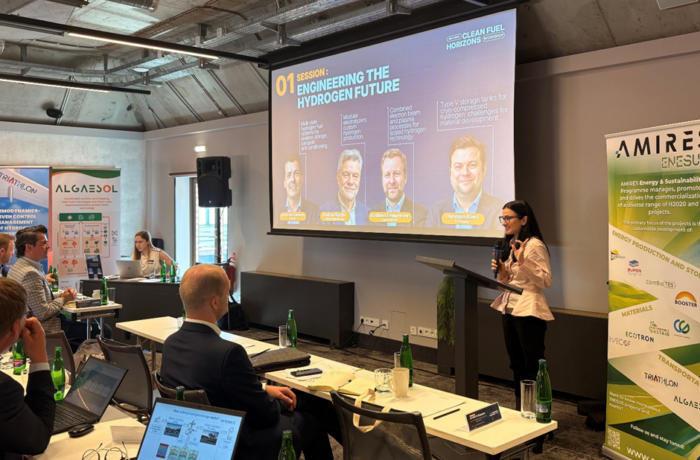
The first session, Engineering the Hydrogen Future, focused on the technological building blocks required to make hydrogen systems viable, efficient and scalable. The discussion moved across materials, storage concepts, component design and production systems, showing how progress in hydrogen often depends on advances that happen behind the scenes — in engineering details, material performance and process integration.
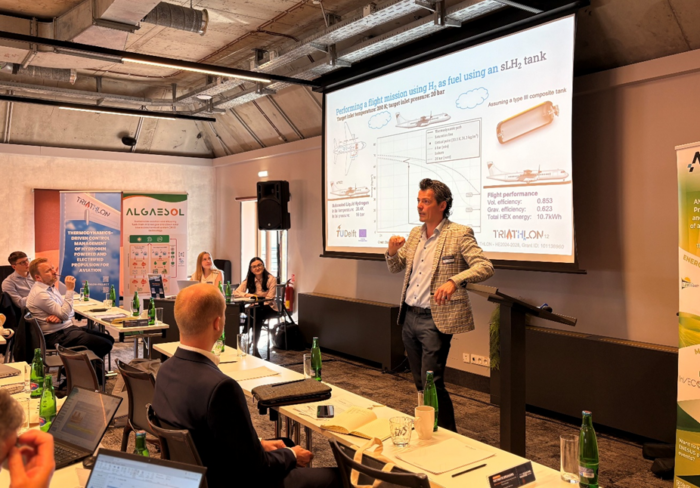
A key contribution came from Julien van Campen from Delft University of Technology, the technical coordinator of the TRIATHLON project, who presented on multi-state hydrogen fuel systems for aviation, with a focus on storage, transport and conditioning. His presentation highlighted the necessity to design a hydrogen powertrain for aviation as an integrated system, rather than a collection of individually optimized components. Hydrogen can only become a practical fuel option for aviation when we let go of the dogma that liquid hydrogen is the only viable solution for aviation.
The session continued with Vladimír Matolín, CEO of Leancat Electrolyzers, who brought the conversation to hydrogen production. His presentation on modular electrolysers for custom hydrogen production showed how flexible production technologies could help tailor hydrogen supply to specific industrial needs and use cases. Further broadening the technical discussion, Burkhard Zimmermann of Fraunhofer FEP introduced the role of combined electron beam and plasma processes in scaling hydrogen technologies.
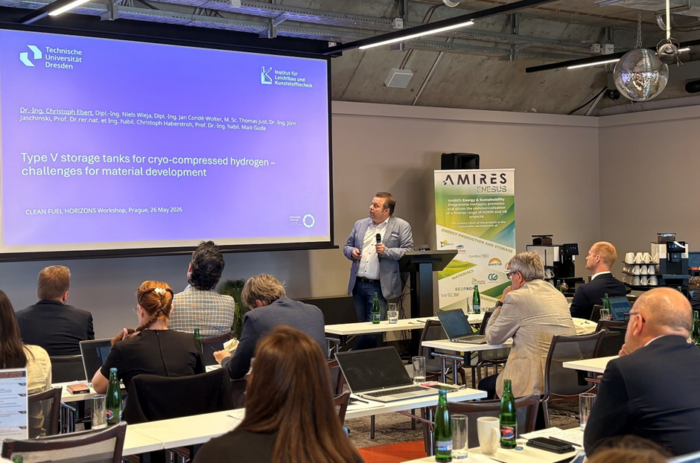
The final presentation of the first session returned to hydrogen storage, with Christoph Ebert of TU Dresden examining the material challenges behind Type V storage tanks for cryo-compressed hydrogen. His talk provided insight into the behaviour of materials under hydrogen and cryogenic conditions, drawing attention to the importance of testing, degradation analysis and long-term performance in the development of next-generation storage solutions. Together, the TRIATHLON contributions from Julien van Campen and Christoph Ebert illustrated how the project is advancing innovation in hydrogen systems and storage for future applications.
The second session, Industrial Integration of Hydrogen: From Engineering to End Use, shifted the focus from technology development to the realities of implementation. Here, the workshop moved into the question of how hydrogen solutions can find their place in operational industrial environments, and what is needed to scale promising concepts into robust applications. The session explored the intersection between engineering, utility, cost, infrastructure and industrial uptake, reinforcing the idea that deployment depends on more than technical feasibility alone.
The presentations and exchanges during this session reflected an increasingly important theme in the clean energy conversation: innovation is only meaningful if it can be absorbed into real industrial contexts and made relevant to users, operators and investors.
The final session, Renewable Fuels and Bio-based Chemical Solutions, expanded the workshop’s perspective beyond hydrogen and placed greater emphasis on complementary fuel pathways. This session focused on the production of renewable fuels and bio-based solutions for sectors such as aviation, shipping and industry, exploring how biological and solar-driven approaches can contribute to a broader sustainable fuel ecosystem.
Throughout the event, one point became increasingly clear: the discussion around clean fuels is no longer only about what is technically possible. It is also about where projects fit in the wider system, how costs evolve, how policy supports or constrains deployment, and how different technologies can coexist rather than compete. Speakers approached these questions from different angles, but together they painted a picture of an energy transition that is complex, interconnected and highly dependent on collaboration.
That collaborative aspect was visible not only in the presentations, but also in the atmosphere of the workshop itself. Beyond the formal sessions, Clean Fuel Horizons offered valuable opportunities for networking, informal discussion and knowledge exchange. Participants moved between technical detail and strategic reflection, comparing perspectives across sectors and identifying shared challenges. In this sense, the event functioned not only as a dissemination activity, but also as a meeting point for communities that do not always have the chance to interact directly.
For TRIATHLON and ALGAESOL, the workshop served as an important opportunity to position their work within a broader European conversation on sustainable fuels. It also highlighted the role of AMIRES in building bridges between project results and the wider innovation ecosystem, helping research-driven initiatives connect with policy debates, industrial needs and future partners.
By the end of the day, Clean Fuel Horizons had done more than showcase technological advances. It had framed a broader conversation about what it will take to make sustainable fuels a reality — from hydrogen systems and advanced storage to renewable fuel pathways and industrial integration. In doing so, the workshop reflected both the urgency and the opportunity of the transition ahead.
TRIATHLON would like to thank all speakers, participants and partners who contributed to the success of the event. The conversations started in Prague are far from over — and the momentum created during the workshop offers a strong foundation for future collaboration, knowledge exchange and the next steps in advancing Europe’s sustainable fuel landscape.
Watch the official event after movie to catch the highlights, and head over to the AMIRES website for the full breakdown of insights from the day!